

Why Tracking Your Reels Count Works Better Than Standard Screen Time Limits
You unlock your phone just to check one quick message. Then, an Instagram notification flashes. You tap it. A recipe video leads to a comedy clip, which rolls into a travel recommendation, which turns into an unhinged podcast snippet.Suddenly, your thumb has moved fifty times. Thirty minutes vanished into thin air. Most of us measure digital fatigue by hours and minutes. We glance at built-in screen time summaries, feel a brief twinge of guilt, and swipe the report away. But minutes don’t tell the real story of short-form addiction. What actually strains your nervous system is the raw volume of disjointed media clips shoved into your working memory back-to-back: your daily Reels Count.
Understanding your Reels Count—and actively tracking it—changes how you interact with your phone. Here is what actually happens when you swipe continuously, why traditional time limits fail, and how granular tracking can restore your focus.
The Illusion of Screen Time: Why Minutes Lie
Standard phone monitoring tools group everything together. Twenty minutes spent reading an eBook or following a turn-by-turn map registers the exact same way as twenty minutes spent blitzing through TikToks or YouTube Shorts. Cognitively, though, they are polar opposites. Reading an article involves sustained attention on a single narrative thread. Your brain creates a mental model, predicts upcoming context, and operates in a relatively calm rhythm. Short-form video feeds do something radically different:
- Micro-context shifts: Every swipe forces your brain to recalibrate setting, tone, volume, facial expressions, and narrative context within two seconds.
- Variable reward schedules: You never know if the next swipe will be boring or exhilarating. That slot-machine mechanic keeps dopamine surging in anticipation.
- Vanishing stopping cues: Traditional media had natural stopping points: chapter breaks, commercial breaks, ending credits. Feeds remove these cues completely.
If you spend thirty minutes watching an educational documentary, you processed one coherent concept. If you spend thirty minutes scrolling, your Reels Count might sit between 60 and 90 distinct pieces of content. That is nearly one hundred distinct visual worlds forced through your cognitive filters before breakfast.
The Neurological Cost of an Unchecked Reel Count
When your Reels Count quietly ticks into the hundreds every day, your brain adapts—just not in ways you want.
1. Attentional Fragmentation
Short-form platforms train your attention mechanism to demand a payoff every 15 to 30 seconds. When you sit down to tackle a task that requires 20 minutes of friction before feeling rewarding—like studying, drafting a report, or practicing an instrument—your brain treats that lack of instant stimulation as an emergency. You reach for your phone not out of boredom, but out of sensory withdrawal.
2. Dopamine Exhaustion
Dopamine is the neurotransmitter of pursuit, not satisfaction. Every swipe delivers a minor spike. When you rack up an excessive Reels Count over several hours, baseline dopamine sensitivity drops. The result is a familiar kind of modern lethargy: feeling wired yet exhausted, unable to focus on work, but equally unable to relax and enjoy silence.
3. Memory Degradation
Memories require consolidation to move from short-term holding buffers into long-term storage. When one concept is immediately overwritten by another clip seconds later, the brain simply purges the previous clip. Ask yourself honestly: how many reels that made you laugh yesterday can you actually remember right now?

Why Standard App Timers Consistently Fail
Most people have tried setting a 30-minute daily timer on social apps. Most people also know the routine of tapping “Ignore limit for 15 minutes” until the timer becomes completely meaningless background noise. Timers fail because time feels abstract when you are in a flow state. Minutes slip away quietly. A counter, however, is concrete.
| Measurement Type | How It Feels | Behavioral Impact |
| Duration (Minutes) | Passive, continuous, easily rationalized | “I’ve only been on here 15 minutes, that’s not bad.” |
| Volume (Reel Count) | Discrete, behavioral, undeniable | “I just watched 85 separate videos in a row.” |
Seeing a discrete number forces an active evaluation of your physical habit. Swiping your thumb eighty times represents eighty individual micro-decisions to consume more media.
Practical Ways to Measure and Control Your Feed
Taking back your time does not require throwing your smartphone into the ocean. It requires making passive consumption visible and adding deliberate friction.
Make the Consumption Measurable
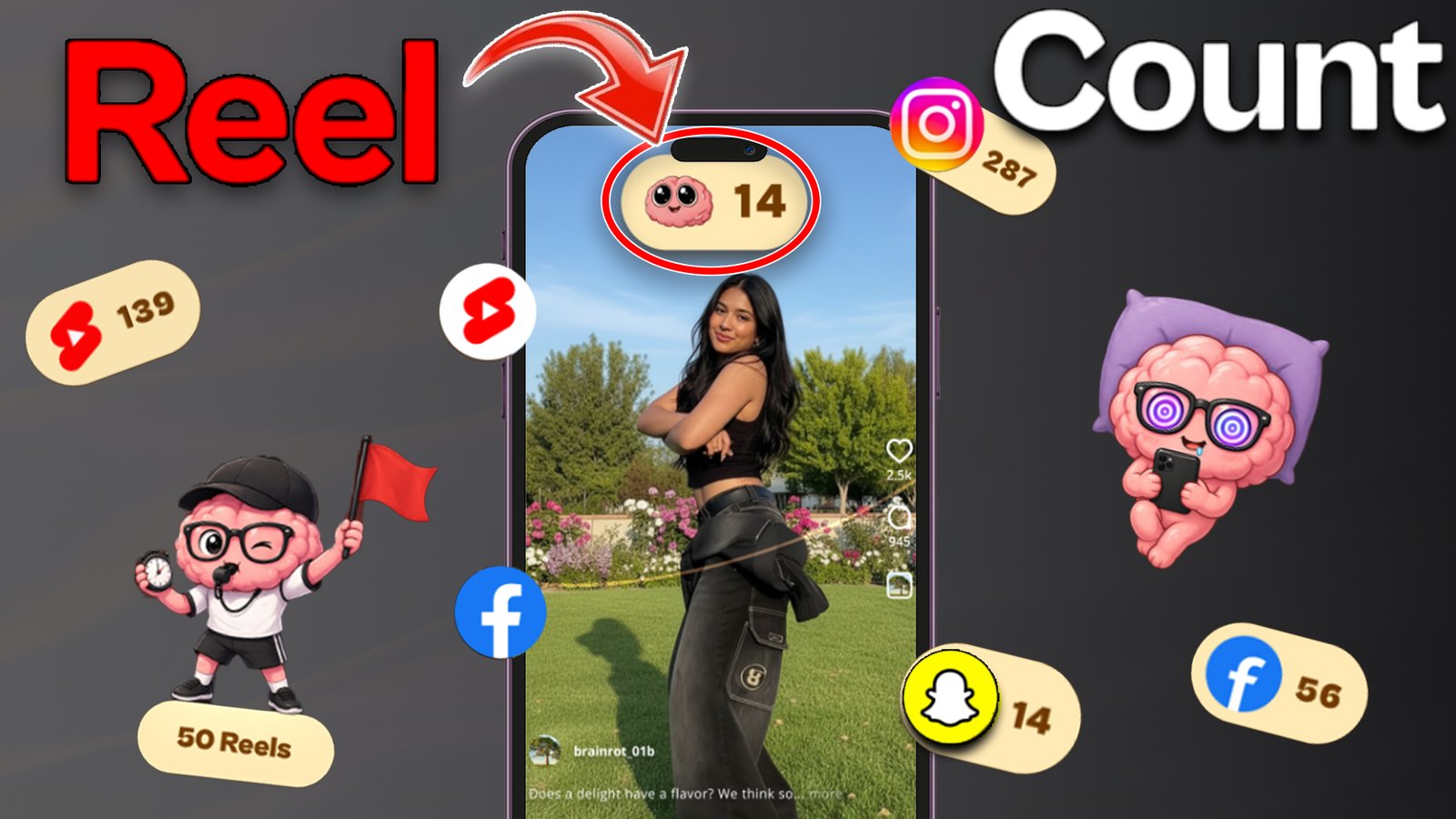
Use dedicated utilities or native logging to see the actual number of clips you consume across platforms like Instagram Reels, YouTube Shorts, Facebook, and Snapchat. Dedicated scroll-counting utilities (such as BrainPal and similar accessibility-based trackers) expose the raw number live on your screen as you browse. When you watch that number tick from 20 up to 70 in real time, the subconscious trance breaks.
Gamify the Reduction
Turn scroll reduction into an objective metric:
- Establish your baseline: Track your uninhibited consumption for three normal days without judging yourself. Find your average daily Reels Count.
- Set a hard ceiling: If your baseline is 120 reels a day, set an initial cap at 80.
- Run social challenges: Compare daily totals with a friend or colleague. Whoever logs the lower Reels Count by 9:00 PM wins. Accountability removes isolation from the habit.
Introduce Strategic Friction
- Turn off autoplay previews: Prevent videos from loading before you intentionally click them.
- Keep short-form off the home screen: Move media-heavy apps into nested folders so you cannot tap them on pure muscle memory.
- Hard stops over soft nudges: If you hit your target count for the afternoon, use tools that lock the short-form sections of the app rather than relying purely on willpower when tired.
Reclaiming Your Mental Bandwidth
Short-form video is engineered by teams of data scientists specifically to bypass conscious decision-making. Beating that architecture with sheer willpower rarely holds up over the long haul. The secret to stopping isn’t guilt; it is clarity. When you stop looking at vague hours and start confronting your actualReels Count, the trance dissolves. You realize that watching 150 clips back-to-back rarely gave you joy, rest, or insight—it just kept your thumb moving. Start tracking the raw numbers. Once you see the scale of the habit clearly, stepping away becomes the easiest choice you make all day.
Frequently Asked Questions
What is a healthy daily Reels Count?
There is no universal medical threshold, but context matters. If your daily Reels Count stays under 20 to 30 clips during dedicated break periods, it rarely disrupts deep work or sleep. If your count routinely crosses 100 to 150 clips daily, you are likely experiencing attention fragmentation, task-switching friction, and delayed sleep onset.
Why does tracking Reels Count work better than tracking screen time?
Screen time measures passive duration, which blends active work, messaging, navigation, and entertainment into a single number. Tracking your Reels Count targets the specific, repetitive physical action of swiping through rapid-fire algorithmic feeds. Seeing a concrete unit (e.g., 65 videos watched) creates immediate awareness that passive minute counters fail to trigger.
Do short-form video counters drain phone battery or compromise privacy?
Dedicated counters generally utilize Android or iOS accessibility services to log swipe events inside targeted app interfaces. Legitimate tracking tools process this logic locally on your device without transmitting video history or personal credentials to external servers. Because they listen for basic layout updates rather than processing heavy graphics, their battery footprint is typically minimal.

Watch Full Video