

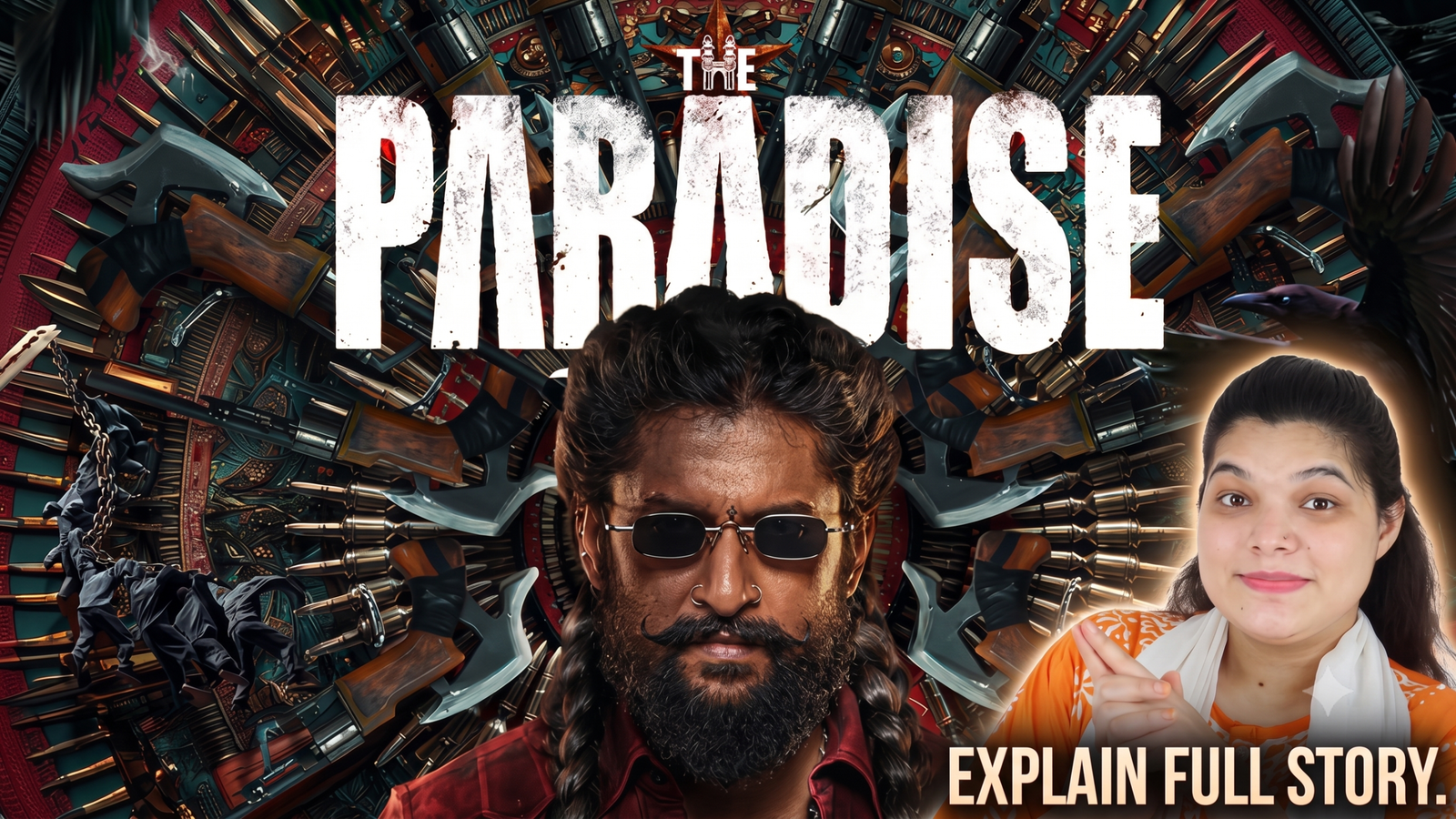
The Paradise Movie Review: An Exhausting Political Drama That Tests Your Patience
Are you planning to head to theaters this weekend expecting a high-octane, gripping action thriller? Before you spend your hard-earned money and commit three full hours of your weekend, hit pause.
While pre-release trailers often build colossal expectations, the reality inside the theater can be wildly different. In this detailed The Paradise Movie Review, we examine every angle of the film—from Natural Star Nani’s intense screen presence and Raghav Juyal’s underutilized villainy to the screeching sound design and sluggish political narrative—to see whether it deserves your time.
Film Overview & Key Details
Here is a quick snapshot of the essential technical and production specifications:
| Feature | Details |
| Movie Title | The Paradise |
| Lead Cast | Nani, Raghav Juyal |
| Genre | Political Action Drama |
| Music Composer | Anirudh Ravichander |
| Hindi Dubbing Voice (Nani) | Sanket Mhatre / Sanket Rai |
| Runtime | Approximately 180 Minutes (3 Hours) |
| Languages | Telugu, Hindi, Tamil |
| Final Rating | 1 / 5 Stars |
1. The Core Plot: A Fight for Identity Lost in Translation
At its foundation, The Paradise centers on an oppressed community fighting tooth and nail for their land, civil rights, and cultural identity. Pitted against them are the wealthy, well-connected elites who control the corridors of power in Paradise.
Narrative Execution and Regional Disconnect
On paper, a high-stakes grassroots rebellion anchored by a fiery political protagonist sounds promising. However, the film struggles drastically in translation to the screen:
Alienating Regional Politics: The film leans heavily into localized socio-political dynamics. While regional viewers familiar with the landscape might catch subtle allegories, mainstream audiences in North and West India will find the complex power dynamics confusing and distant.
Erratic Narrative Pacing: The screenplay sprints forward without allowing dramatic moments to breathe. Sequences clash into one another, leaving zero room for organic character development or emotional stakes.
Severe Bloat: The story holds barely enough substance for a crisp 90-minute feature. Stretching it across an agonizing three-hour canvas leaves viewers constantly looking at their watches.
2. Cast Performances: Dedication Betrayed by the Script
Even the most committed actors cannot rescue a story stripped of genuine dramatic tension and sensible dialogue writing.
Natural Star Nani: Raw Charisma in a Flawed Frame
Nani proves once again why he is revered as a performer. He commits fully to his gritty, intense persona, bringing genuine rage, fiery glances, and an imposing physical presence to his role. He plays the aggressive community champion with conviction, but the surrounding script repeatedly undermines his efforts with disjointed scene transitions and hollow payoff.
Raghav Juyal: A Massive Step Backward After Kill
Following his terrifying, breakthrough performance as a psychopathic antagonist in Kill, expectations for Raghav Juyal were sky-high. Unfortunately, the direction completely mismanages his menacing potential:
Rather than delivering chilling intimidation, his character entrance feels jarring and awkward, drawing unintentional chuckles from the theater crowd instead of dread.
He is burdened with flat, caricature-like dialogues that fail to establish him as a genuinely formidable adversary.
An explosive actor is essentially reduced to a decorative, unconvincing villain.
3. Direction, Editing, and Technical Pitfalls
A high-profile action drama requires tight editing and dynamic sound mixing to keep the adrenaline pumping. Here, technical execution becomes the production’s biggest enemy.
Twenty Minutes of Momentum in a 180-Minute Void
Out of a punishing three-hour runtime, only two segments manage to generate real cinematic energy:
The Opening 10 Minutes: An atmospheric introduction that builds anticipation.
The First 10 Minutes Post-Interval: A brief spike in kinetic action and forward motion.
Outside of these brief sparks, the pacing grinds to a near halt, drowning in repetitive confrontations and meandering plot detours.
Deafening and Intrusive Sound Design
Anirudh Ravichander has composed some of Indian cinema’s most iconic modern scores, but here the background music works against the narrative. The BGM is mixed so aggressively loud that it frequently drowns out pivotal character dialogue. Instead of enhancing dramatic weight, the relentless wall of sound induces fatigue long before the third act arrives.
4. The Hindi Dubbing: The Lone Bright Spot
If there is one technical aspect that genuinely stands out, it is the remarkable work done by the Hindi dubbing voice artist.
Providing the Hindi voice for Nani’s character, the dubbing artist delivers a gritty, authoritative, and baritone-rich vocal performance. Every line is delivered with measured weight, elevating Nani’s raw on-screen charisma and making several poorly written scenes watchable for Hindi-speaking viewers. The voice work carries an authenticity that the film’s native writing frequently lacks.
5. Weighing the Pros and Cons
For a quick, objective summary of where the movie succeeds and fails, review the breakdown below:
Strengths
Nani’s Screen Presence: Full-throttle dedication and fierce visual styling from the lead star.
Superb Hindi Voice Dub: Exceptional vocal texture and punch that elevate the lead character’s lines.
Family-Friendly Elements: The film steers clear of cheap vulgarity and gratuitous explicit language.
Weaknesses
Punishing Runtime: A bloated 3-hour duration that drains viewer interest.
Overbearing Audio Mix: Intrusive background music that frequently overrides spoken dialogue.
Wasted Antagonist Potential: Raghav Juyal is relegated to an ineffective, cartoonish villain arc.
Inaccessible Political Jargon: A convoluted thematic structure that struggles to resonate broadly outside localized contexts.
The Paradise Movie Review: Is Nani and Raghav Juyal’s Big-Screen Action Drama Worth Your Ticket?
Final Verdict
The Paradise is an exhausting, overstuffed cinematic misfire. Despite Nani’s earnest commitment and standout Hindi vocal dubbing, the film is weighed down by an incoherent political script, deafening sound design, and an unnecessarily prolonged runtime. Unless you are an absolute completionist fan of the lead actor, you can safely skip the theatrical trip and wait for its eventual digital streaming release.
Frequently Asked Questions
1. Does The Paradise work as a true Pan-India action film?
No. The movie relies heavily on specific regional political subtexts that fail to engage broad audiences across the country. Even the filmmakers acknowledged during promotions that it was not designed under the standard Pan-India commercial mold.
2. Is The Paradise suitable for family viewing?
Yes, the movie avoids vulgarity, explicit scenes, and offensive profanity, making it technically suitable for family audiences. However, its sluggish pace and three-hour duration may test the patience of children and casual viewers alike.
3. How is Raghav Juyal’s performance compared to his work in Kill?
It is a stark letdown. While Raghav showed terrifying range in Kill, The Paradise saddens with weak writing and poor character framing, rendering his antagonist role hollow and ineffective.
4. Is the background score worth listening to in theaters?
While composed by Anirudh Ravichander, the score is mixed excessively loud in several sequences, often swallowing key dialogue and creating auditory fatigue rather than dramatic excitement.